

On Friday, 13 June 2026, thousands of businesses, developers, and content creators lost access to two of the most powerful AI tools on the market with no prior warning. Anthropic, the company behind Claude, was forced to disable its newly launched Fable 5 and Mythos 5 models across all customers worldwide, just three days after their release.
There was no gradual phase-out or alternative provided. The models were just gone!
If your business depends on a ‘rented’ platform, whether that is a social media channel, an AI tool, or a third-party system, this event should be a wake-up call. You do not own these platforms and everything that runs on someone else’s infrastructure can be switched off without your permission.
What Happened With Anthropic’s Fable 5 and Mythos 5
On 12 June 2026, the U.S. Commerce Department issued an export control directive instructing Anthropic to suspend access to its two flagship models, Fable 5 and Mythos 5, for all foreign nationals. Because compliance would have required Anthropic to verify the nationality of every individual user, the only viable path was to disable the models entirely for all customers globally.
Anthropic stated clearly: “The net effect of this order is that we must abruptly disable Fable 5 and Mythos 5 for all our customers to ensure compliance.” This is the first time a leading AI company has publicly taken a deployed model offline due to government intervention.
The trigger was a reported jailbreak technique that the government claimed could unlock Mythos’s advanced cybersecurity capabilities. Anthropic disputed the severity of the finding, but the directive stood regardless of that disagreement.
Key takeaway: A decision made between a government and a technology company, in which you had no voice and no vote, removed tools your business may have been relying on. This is the nature of rented infrastructure.
It Has Happened Before and It Will Happen Again!
The Anthropic incident is dramatic, but it sits in a long line of platform disruptions that have blindsided businesses of all sizes. Consider what has already happened across the digital landscape:
$1 Billion Monthly Revenue at Risk
When TikTok went dark for 14 hours in the United States in January 2025, digital advertising prices on competing platforms surged by 10% overnight as advertisers scrambled to reallocate budgets. In these circumstances, smaller advertisers face a disproportionate impact because they lack the budget and expertise to switch platforms quickly.
TikTok itself estimated that a full ban could cost small businesses and creators over $1 billion in monthly revenue. According to eMarketer, approximately 7.5 million U.S. businesses operated on TikTok, collectively employing 28 million workers, with 74% reporting the platform had directly boosted sales, expansion, or hiring.
A 50-70% Drop in Organic Reach Overnight
In 2021, Facebook updated its News Feed algorithm to prioritise posts from friends and family over business pages. The result was catastrophic for brands that had spent years building their organic followings. According to Social Targeter, many small businesses reported a 50 to 70 percent decrease in organic reach following that single algorithmic update.
By 2025, Sprout Social data cited by industry analysts showed that 87% of businesses reported significant reach decline over the preceding 18 months on Instagram alone. An account with 10,000 followers that previously reached 1,000 to 1,500 people per post was now reaching only 200 to 300.
Source: Sprout Social 2025 Instagram Statistics via Jasmine Directory (jasminedirectory.com)
The Platform Policy Churn You Do Not Notice Until It Hurts
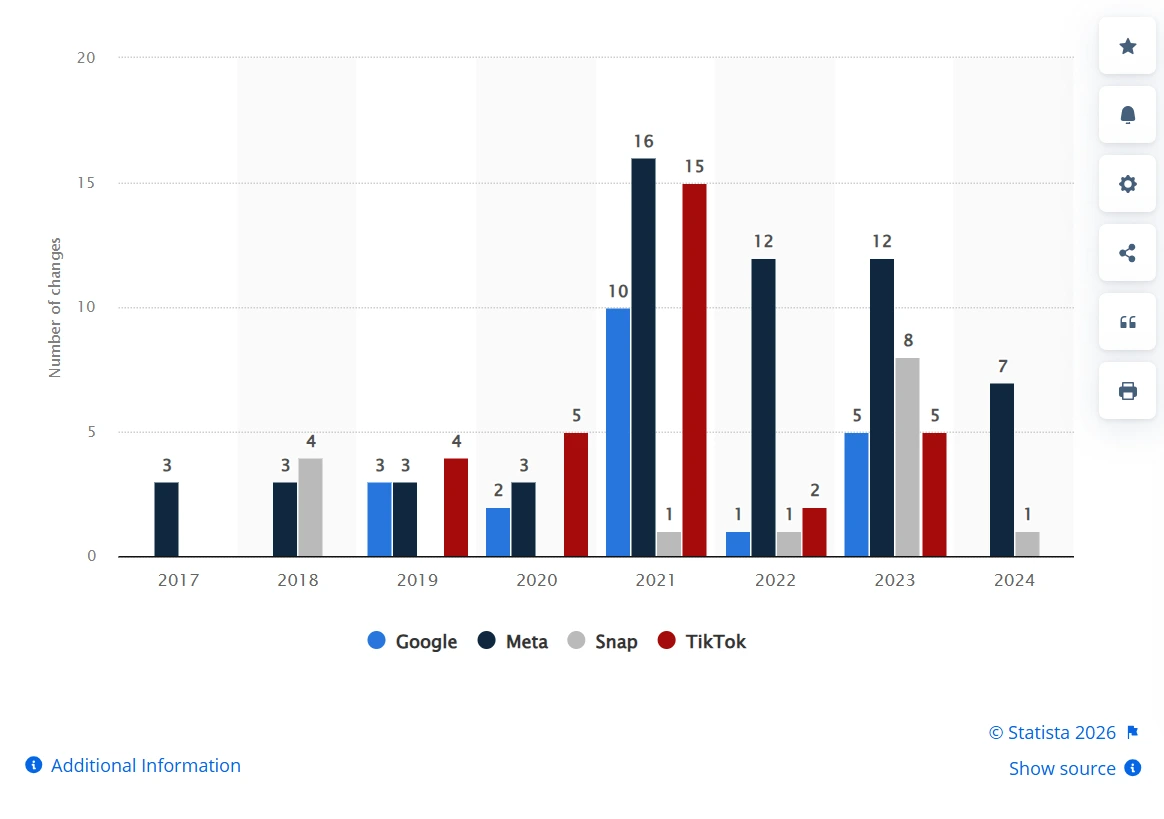
According to research from the London School of Economics published on Statista, major social media platforms including Meta, TikTok, Google, and Snap collectively made dozens of policy and legislation changes annually between 2017 and 2024. In 2021, Meta made 16 separate policy changes. In 2022 and 2023, Meta made 12 separate policy changes each year. Each one of those changes has the potential to affect how your business reaches its audience, prices its advertising, or accesses its data.
Source: London School of Economics via Statista (statista.com/statistics/1607472/changes-social-media-companies-by-platform)
The AI Infrastructure Trap: You Are Renting the Foundation
Social media is not the only rented system businesses have come to depend on. Increasingly, AI tools such as ChatGPT, Claude, Gemini, and others are being embedded into business workflows as if they are permanent infrastructure. They are not.
“We see a future where intelligence is a utility, like electricity or water, and people buy it from us on a meter.”
Sam Altman, CEO of OpenAI – BlackRock Infrastructure Summit, March 2026
Altman’s utility analogy is more alarming than it sounds. Electricity and water are regulated public infrastructure with price controls and universal access mandates. AI is not. A metered model where you pay per query or per ‘unit of intelligence’ would most likely eliminate free tiers entirely, pricing out individuals and small businesses who currently rely on free access to compete with larger rivals.
The irony is that OpenAI was founded in 2015 as a non-profit ‘for humanity’s benefit.’ By 2026, it has converted to a for-profit structure, raised at a $300B valuation, and is openly positioning AI access as a product to be sold.
The Four Risks of Rented Platforms at a Glance
| Risk Type | How It Shows Up | Real Example |
|---|---|---|
| Price Changes | API costs rise, ad spend costs surge, subscriptions tier up | TikTok outage caused 10% surge in Meta ad prices overnight |
| Algorithm Changes | Content reaches fewer people | Facebook 2021 update caused 50-70% organic reach drop for businesses |
| Feature Changes | Tools change or disappear | Instagram’s 2016 shift from a chronological feed to an algorithm-based feed affecting reach and visibility of brands |
| Availability | Platform banned, model disabled, account suspended without notice | Fable 5 and Mythos 5 disabled suddenly for all the users globally |
Why Small Businesses Fall Into This Trap
This is not about negligence. Small businesses adopt these platforms because they work, and because they lower the barrier to entry in ways that were unimaginable a decade ago. The problem is not using the platform; the problem is structuring your entire business around it.
67% of small businesses now rely on social media for sales, and for many of them these platforms have evolved from marketing tools into the primary engine of customer acquisition, retention, and conversion. That is not a marketing strategy; that is a dependency.
Source: The Small Business Expo (thesmallbusinessexpo.com)
The pattern typically looks like this:
- A founder starts an Instagram page, grows an audience, revenue follows and the page becomes the business.
- A solopreneur builds their content workflow around a specific AI tool. Their prompts, their templates, their outputs, all dependent on that tool remaining available and affordable.
- A coach builds a course on a platform that handles payments, hosting, and delivery. When the platform changes its terms or pricing, the entire revenue model is disrupted. The coach may succumb to the new pricing even if it lowers the margins significantly, because it might be too costly and time consuming to shift to another platform.
- A small business grows through TikTok organic reach. When the platform goes down for a number of hours, the sales drop.
All of these businesses built on rented land, and rented land can be taken away.
The Practical Way Forward: Own What Matters
The answer is not to abandon these platforms. They are powerful, accessible, and genuinely valuable. The answer is to use them with deliberate boundaries, leveraging their strengths while ensuring your core business infrastructure belongs to you.
Here is a practical framework to reduce platform dependency:
- Own your audience list:
Your social media following is not yours; your email list is. Build a direct channel to your audience through email, WhatsApp, or SMS, where you control the communication without algorithmic interference. - Define platform-independent processes:
Your processes should include steps that do not depend on specific tools. We have recommended steps and templates for the content creation process in this guide. - Diversify your distribution channels:
Do not rely on a single channel for reach or revenue. Combine owned channels (email, website), earned channels (referrals, SEO), and rented channels (social media, AI tools). - Build your website as the permanent home of your brand:
Social profiles can get banned, algorithms can change, and platforms can be shut down. Your website is what protects your credibility and discoverability regardless of what happens to other platforms.
Riyada Alnajah Is Already Teaching This
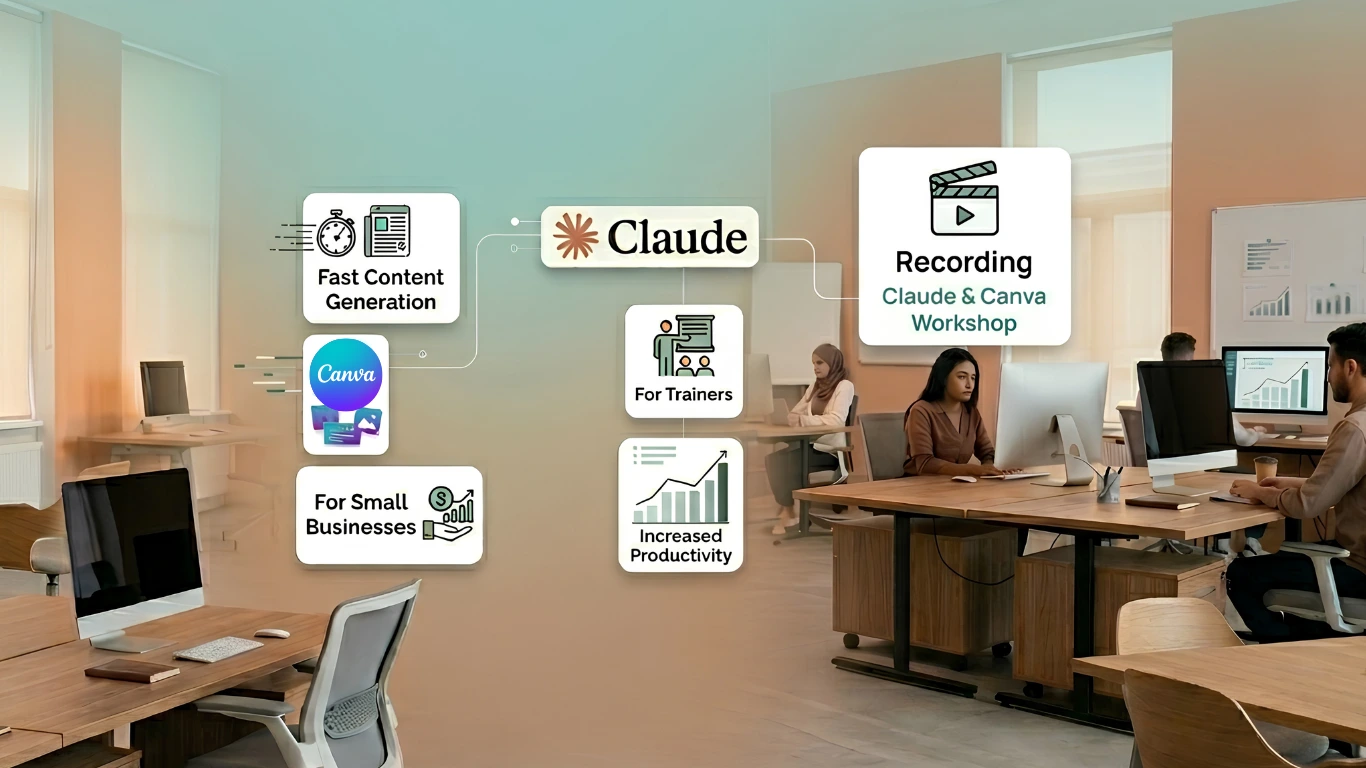
In May 2026, Riyada held a practical workshop for business owners and coaches on exactly this challenge. The session focused on how to use Claude (Anthropic’s AI) and Canva together for content creation, with a focus on building a content process that works regardless of which tools exist. The tools were taught as interchangeable components within that process, not as the process itself.
The Anthropic incident the following month made the lesson concrete. A business owner who had attended that workshop and built a platform-independent content process could look at the Fable 5 shutdown and think: “I know what to do.”
The workshop recording and templates are available on demand.
The Bottom Line
Rented platforms, including social media channels and AI tools, are not your enemy. They are extraordinarily useful, but they are tools, not foundations. When you rent a house, you do not knock down the walls and assume you will live there forever. You make it comfortable and functional, while knowing the lease has terms you did not write.
Use any platform: Instagram, Claude, TikTok, or ChatGPT, but make sure you own your audience, content, process, and website. Build the parts that cannot be taken from you, and use the rented parts as amplifiers, not foundations.